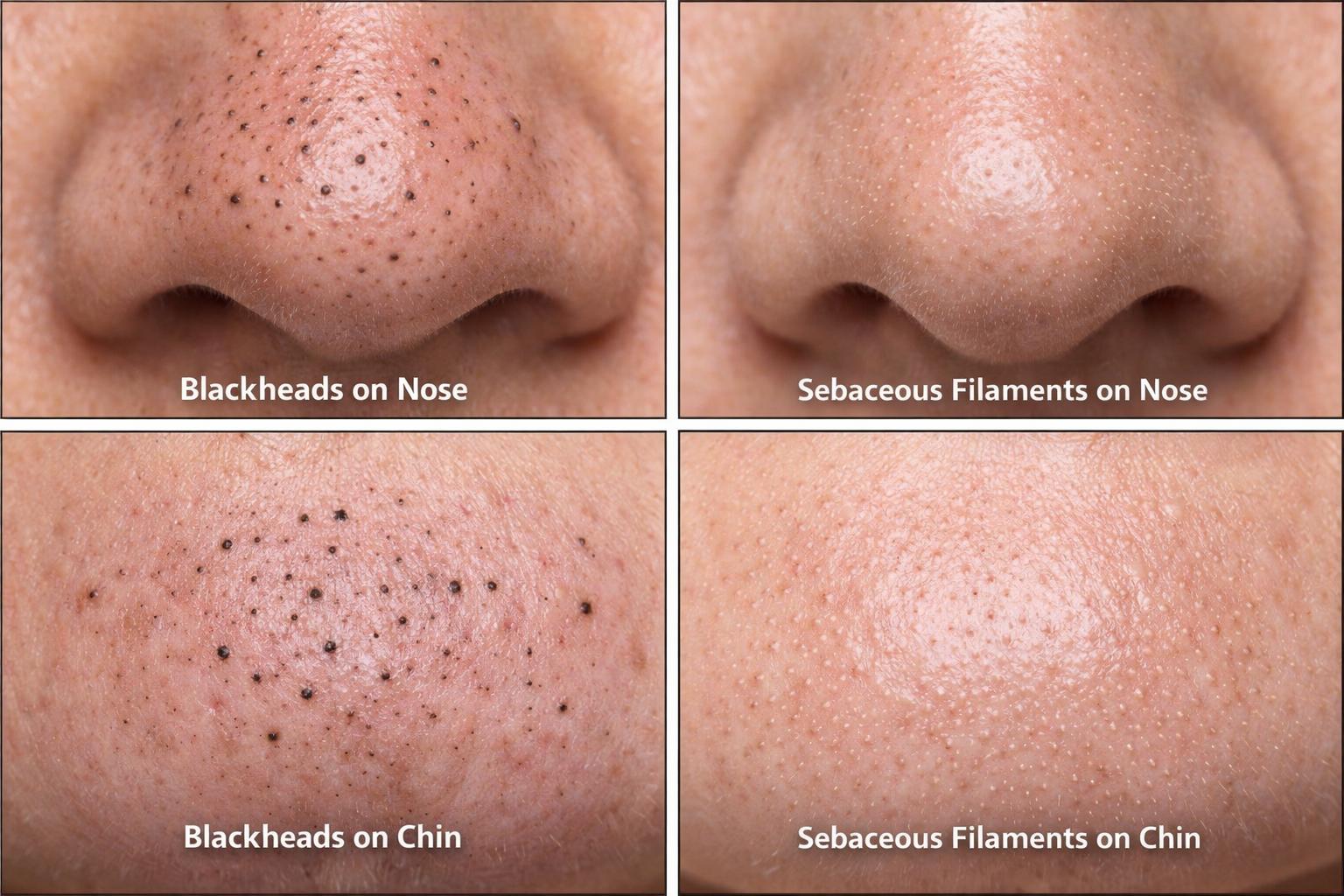
If I had a dollar for every time a client pointed to their nose and said,
"I have so many blackheads…"
…I’d be retired.
As an esthetician in Falmouth, Maine, here’s what I see every single week in the treatment room:
A lot of what people think are blackheads… aren’t blackheads at all.
And once you understand the difference, everything about how you care for your skin starts to make a whole lot more sense.
What Are Blackheads?
Blackheads are clogged pores.
They form when oil and dead skin cells get trapped inside the pore, and when that buildup hits the air, it darkens. That darker color isn’t dirt—it’s oxidation.
Where you’ll see them:
- Nose
- Chin
- Forehead
More common in:
- Oily or acne-prone skin
- Hormonal fluctuations
These are something we can improve with the right treatment and routine.
What Are Sebaceous Filaments?
This is where most of the confusion happens.
Sebaceous filaments are completely normal. Everyone has them.
They live inside your pores and help move oil from within your skin up to the surface. That oil is there to protect and keep your skin balanced.
So when clients ask how to get rid of them—the honest answer is:
You don’t.
Why They Look Like Blackheads
Sebaceous filaments can look like:
- Tiny dots in the pores
- Slightly gray or darker at the surface
- Most noticeable on the nose
Here’s the easiest way to tell:
👉 Evenly spaced across the nose = likely sebaceous filaments
👉 Random, deeper, more stubborn = likely blackheads
But “Why”?
Your skin is constantly producing oil.
Sebaceous filaments are the pathway that allows that oil to travel through the pore and reach the surface.
When oil builds up in that channel, it becomes more visible.
This isn’t a flaw—this is normal skin function.
What Actually Helps (And What Doesn’t)
Blackheads
What helps:
- Professional extractions
- Gentle, consistent exfoliation
- A solid home routine
What doesn’t:
- Picking
- Over-scrubbing
- Harsh products
Sebaceous Filaments
What helps:
- Keeping pores clean and balanced
- Gentle exfoliation
- Regular treatments
What doesn’t:
- Trying to permanently remove them
- Over-extracting
- Aggressive “quick fixes”
They can be minimized—but they will always return.
Trends vs. Real Treatments
I know those videos are satisfying—the ones where everything looks like it’s instantly pulled out of the skin.
But most of what you’re seeing is temporary… and sometimes damaging.
Healthy skin isn’t about forcing everything out.
It’s about working with your skin so it functions the way it’s supposed to.
Let’s Talk About Social Media for a Minute
I see this all the time—clients trying what they’ve seen online, only to end up more irritated than when they started.
So I’m going to say this clearly:
👉 Stop taking skincare advice from unlicensed and uneducated influencers.
Here’s why:
- Your skin is not one-size-fits-all
- Viral content is designed for views—not long-term results
- Aggressive techniques can damage your skin barrier
- There’s no accountability if something goes wrong
The Bottom Line
Not every dark pore is a blackhead.
And not everything needs to be removed.
Sometimes your skin is doing exactly what it’s supposed to do—you just need to understand it.
Ready for Real Answers?
If you’ve been frustrated trying to figure out what’s going on with your pores, let’s take a closer look together.
No guessing. No overdoing it. Just a plan that makes sense for your skin.
✨ Book your appointment and let’s get you on the right track.